How it works
You run the work in any sandbox; Reeg versions the whole environment and proves what it did, as a record you own.
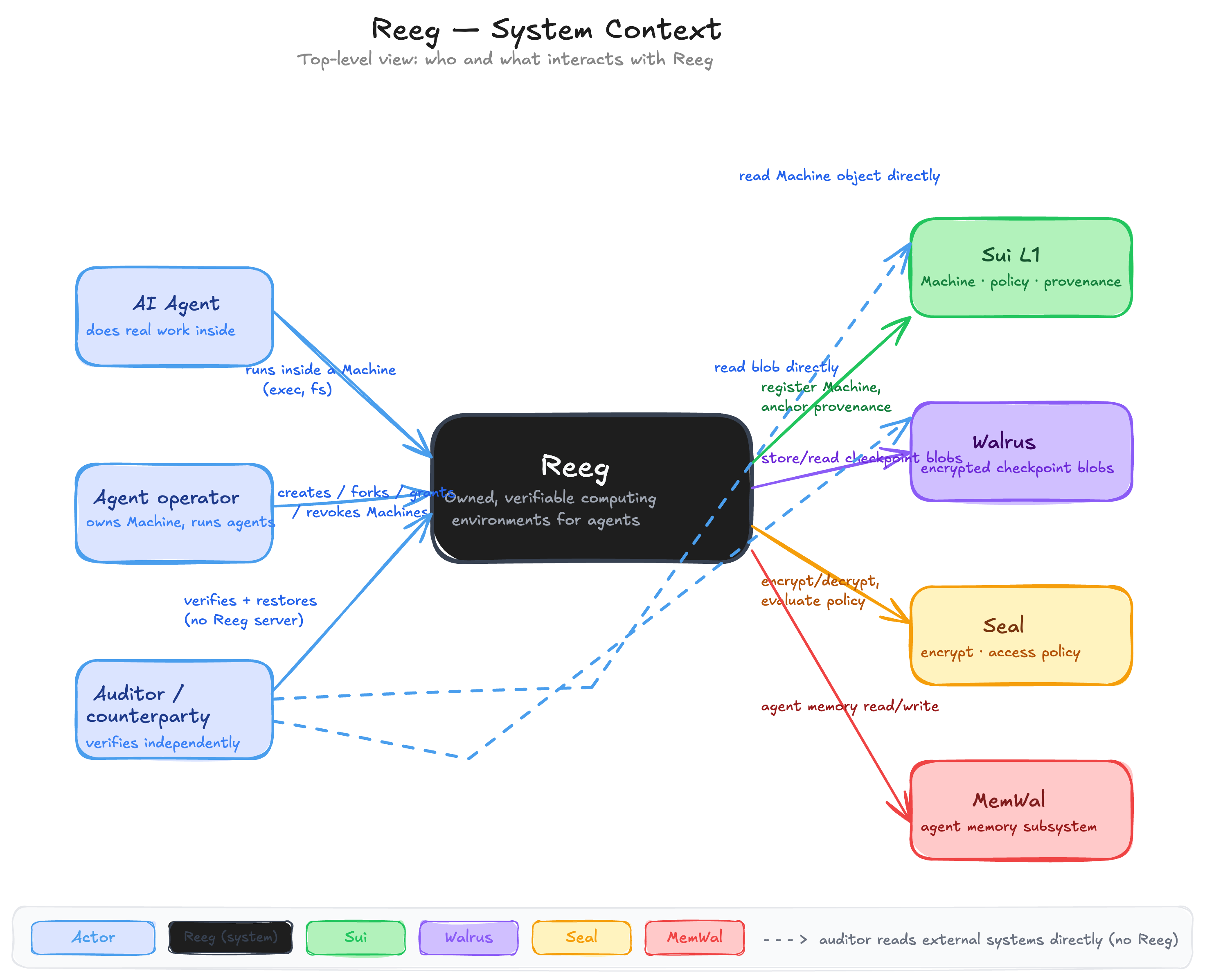
Every important thing in computing became portable. Files (Dropbox). Code (Git). Containers (Docker). Data, too. The environment (the live place the work actually happens) never moved. Reeg makes environments portable. It is the layer over the sandbox: you run the workload, Reeg snapshots, encrypts, anchors, and restores the working state around it.
The loop
Reeg does not run your workload or hold your compute. You run the agent (or a CI job, an eval harness, or a person at a keyboard) in whatever runner you choose: Reeg's local engine, an OCI container, a Firecracker microVM, or someone else's cloud. Reeg waits at the commit boundary. At each commit, it does four things.
- Snapshot. Capture the working directory (plus an optional agent-memory directory) into a content-addressed store keyed by BLAKE3, alongside a manifest: env vars, tool list, memory pointer, and the working-dir root hash. The manifest is serialized canonically: stable ordering, neutralized timestamps and uid/gid, a pinned umask, so the same input always produces the same
manifest_hash. - Encrypt. Seal-encrypt the snapshot on your machine, before it touches the network. You choose the threshold (
reeg checkpoint --threshold t). - Store. Write the ciphertext to Walrus as a content-addressed blob. The
blob_idis the content hash, so the blob cannot be swapped without changing its id. Walrus is your own data, not a row in a vendor's database. - Anchor. Register
blob_id+manifest_hashon aMachineobject you own on Sui, and append a hash-chained record to its provenance log.
This captures the working directory and a manifest, not live kernel or process memory. That is the deliberate choice that makes restore work across machines.
Restore
On any host and any runtime tier, Reeg pulls the blob, decrypts it (if your access policy approves), and rebuilds the working directory from the content-addressed store, byte-identically. Because the capture is content-addressed and deterministic, a restore on a different machine matches the original bit for bit. Drift against the recorded hashes is reported, not hidden.
Byte-identical restore is verified both across different hosts and across runtime tiers: local engine, OCI container, and Firecracker microVM.
Verify, with Reeg switched off
Anyone you choose verifies the full history offline, from public Sui and Walrus data alone: no Reeg backend in the trust path.
- Read the
Machineobject on Sui:owner, currentblob_id,manifest_hash,provenance_head,parent. - Pull the blob from Walrus by
blob_idand checkblob_id == hash(ciphertext). - Recompute
manifest_hashand the working-dir root hash; check them against the object. - Re-walk the provenance chain (
H_n = hash(H_{n-1} || event)) toprovenance_head.
All three match means the environment and its history are exactly what was claimed. Tamper with the blob, the manifest, or any log event and at least one hash diverges, so verify fails. The @reeg/verify offline verifier covers this in CI (54/54).
The four facets: portability
Each one is a kind of portability for the environment.
| Facet | What it means |
|---|---|
| Own | The environment is a Sui object you hold plus a Walrus blob that is your own data, not a record you rent. Only the owner mutates it; no vendor can change it, lock you out, or delete it. |
| Share | Hand over the live workspace, not a transcript. Share Seal-encrypted checkpoints under an on-chain access policy you grant and revoke (allowlist + time-limited). Each grant and revoke appends to the provenance chain. Fork a known-good checkpoint to run two directions at once. |
| Move | Kill it on one machine, bring it back on another: identical. Determinism is pinned at the byte level (canonical umask, neutralized timestamps and ownership), so restore is byte-identical across hosts and runtime tiers. No lock-in to one vendor or datacenter. |
| Prove | Every checkpoint anchors a hash-chained, append-only record on Sui. Anyone verifies the full lineage offline from public data alone. GitHub history can be rewritten; this cannot. |
What's live today
Reeg is live on Sui mainnet and testnet.
- Mainnet package
0xfaa6b4af63a639c06e5d02c969c28111db5f01caea1067132c789fa7ebdb241e; testnet package0x8f2faf0b89e248f498cb0bc4b0ef98511613c4d7884e8ce41f0bc255246ca1d2. - A measured create + encrypted checkpoint (1 epoch, including the Walrus upload-relay tip) costs ~0.0099 SUI + ~0.0119 WAL on mainnet.
- Move package 40/40,
@reeg/verify54/54,@reeg/chain21/21,@reeg/cryptocross-language vector match 8/8, all green in CI. Engine verified on a real AWS KVM host: Firecracker 8/8 plus jailer, OCI 3/3, lib 11/11. - Built on the current Sui stack:
@mysten/sui2.17,@mysten/walrus1.1.7,@mysten/seal1.1.3.
One honest caveat
On mainnet, encryption, storage, anchoring, and offline verification of the record all work today. The decrypt (restore) of an encrypted checkpoint currently waits on a provider's mainnet Seal key server: a provider-availability matter, not Reeg code. The full encrypted checkpoint → restore → verify loop is proven end to end on testnet. We surface this rather than hide it.